Singapore to Ho Chi Minh City: Trip Guide
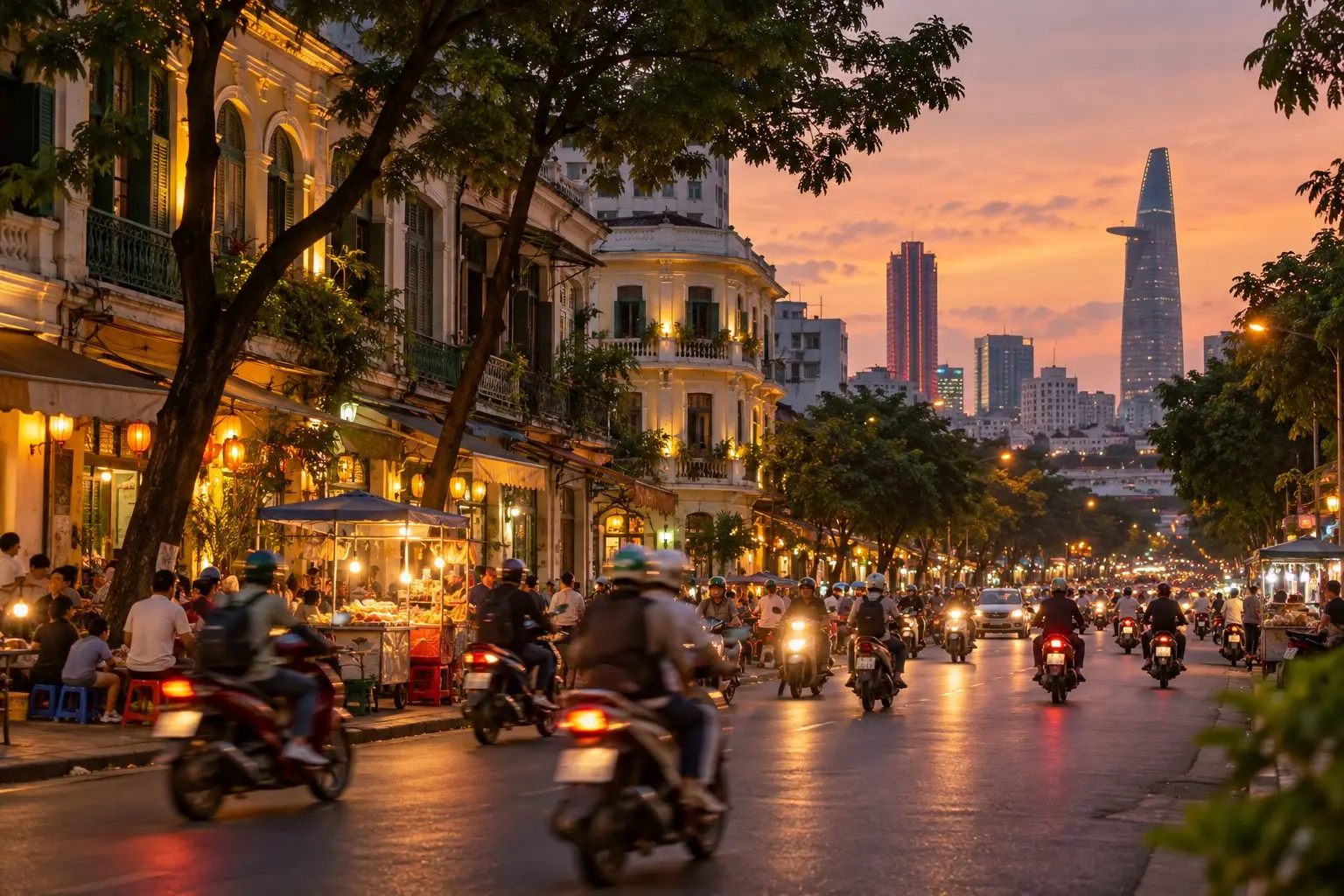
Direct flights from Changi to Ho Chi Minh City (SGN) take about 2 hours 15 minutes. Singapore citizens enter visa-free for up to 30 days per entry, but should carry a return ticket and a passport valid six months.
Ho Chi Minh City - still widely called Saigon - is one of the shortest long-haul-feeling trips out of Singapore: a direct flight of a little over two hours, visa-free entry for a short stay, and energy that hits you the moment you step out of the airport. The rules have a couple of easy-to-miss steps, so here is what to sort before you fly.
The flight
Non-stop flights from Changi to Ho Chi Minh City (SGN) take about 2 hours 15 minutes. It is a busy, competitive route with departures spread across the day, so you can usually match a flight to your plans. Scoot flies it as a low-cost option and departs from Changi Terminal 1, with a 10kg cabin-bag allowance - more generous than most budget carriers - on Airbus A320-family, Boeing 787 and Embraer E190-E2 aircraft. Singapore Airlines runs the route as a full-service option, and Vietnam Airlines and Vietjet Air also fly it, so compare the all-in price including any checked bag before you book.
On fares, Scoot advertises SIN-SGN tickets from around S$162 one way and round-trips from roughly S$165 on quieter dates, though prices climb over Singapore school holidays and Vietnamese festival periods. Treat headline fares as a starting point: a budget ticket with a checked bag and seat selection can end up near a full-service fare that already bundles them.
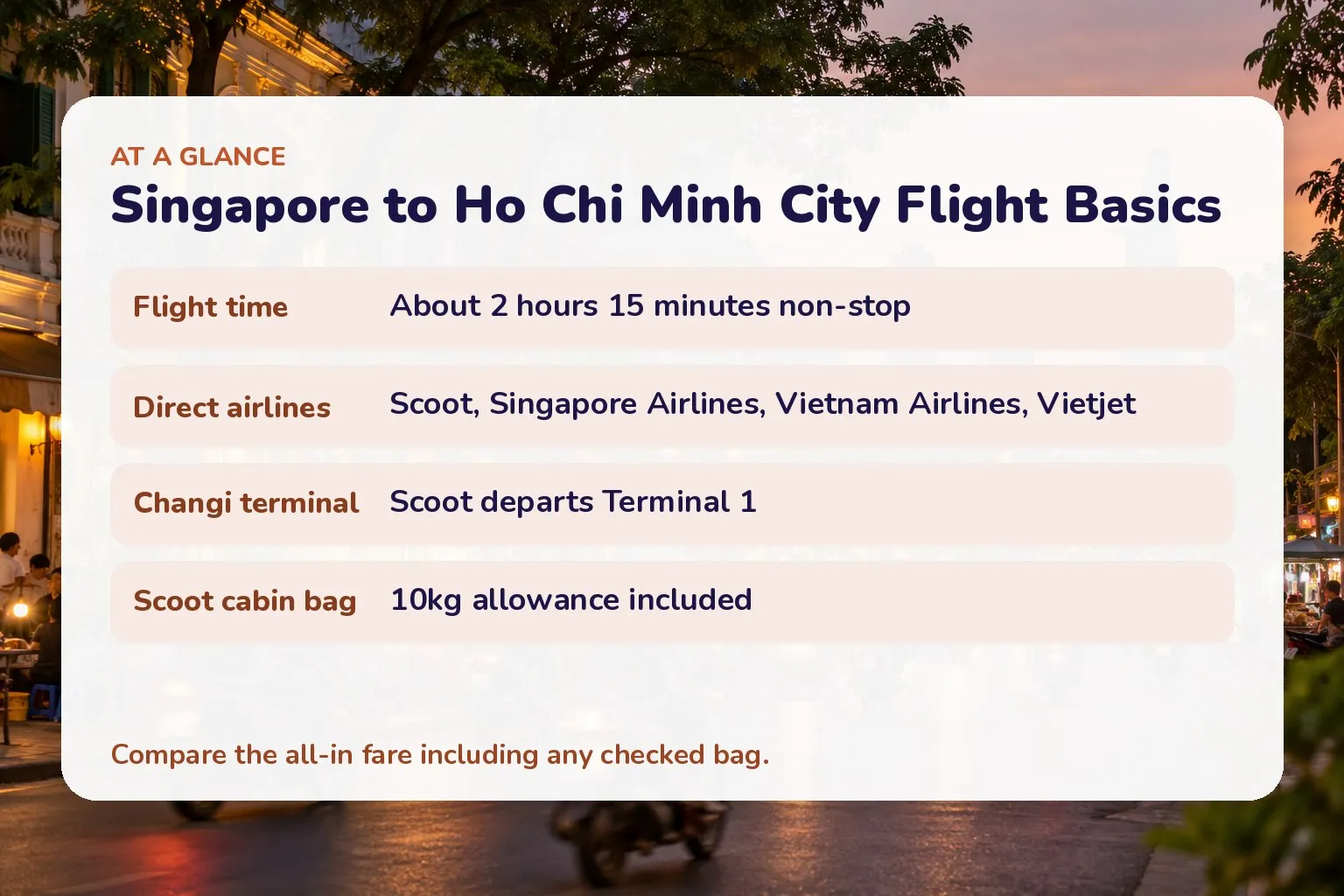
Singapore to Ho Chi Minh City trip basics. Sources: Scoot; MFA Singapore, October 2026.
Entry: 30 days visa-free
Singapore passport holders generally do not need a visa to enter Vietnam and can remain up to 30 days per entry, for tourism, business or family visits, under a long-standing bilateral agreement with no end date. There is no application and no fee for the visa-free entry itself.
Two conditions matter. First, the agreement requires you to carry a return or onward ticket, so have the booking ready to show. Second, your passport should be valid for at least six months after you arrive - the standard regional immigration counters expect. Approval for entry is ultimately at the discretion of Vietnam’s immigration authorities, so keep your paperwork tidy and answer questions straight.
Each entry gives you a fresh 30-day stay with no waiting period between visits, which suits a quick weekend and a later return. When you are stamped in, check the date written in your passport and do not overstay - Vietnam has raised its fines for overstaying and urges travellers to monitor their permitted period closely.
Staying longer: the e-visa
If you want more than 30 days, apply for an e-visa before you travel. It lasts up to 90 days, is usually issued in about three working days, and costs US$25 for single entry or US$50 for multiple entries - roughly S$32 and S$64 at about S$1.28 to the US dollar in late October 2026.
Apply only on the official portal, evisa.gov.vn (or thithucdientu.gov.vn). Many look-alike sites act as middlemen and add their own fees for the same government service. The e-visa and the visa-free entry are for visits only - to work or study you need a visa sponsored by a Vietnamese employer or school, plus a work permit or residence card.
The Tan Son Nhat pre-arrival declaration
This is the step first-timers miss. Under a local requirement, foreign nationals entering Vietnam through Tan Son Nhat Airport in Ho Chi Minh City must submit personal information before arrival. You complete it online at prearrival.immigration.gov.vn (or via the official QR-code system) and receive a confirmation QR code to show immigration officers. Transit passengers are exempt.
Do it in the days before you fly - the MFA notes that failing to complete it in advance can mean longer processing at the checkpoint. It is separate from, and in addition to, the visa-free entry.
Getting into the city safely
Tan Son Nhat sits close to the centre, so the ride is short - but choose your transport with care. The MFA names Vinasun and Mai Linh as the more reputable metered taxi companies in Ho Chi Minh City; app-based options such as Grab, Be and Xanh SM are also widely used and show the fare up front. Agree the fare or insist on the meter before you set off.
Petty crime is the main day-to-day risk. Snatch-thefts and pickpockets are reported, especially in crowded areas and on public transport, and phone-snatching from the roadside is common - keep your bag on the inside shoulder and do not use your phone while walking near traffic. If you take a motorcycle taxi (xe om or Grab bike), wear the helmet; riding without one is illegal. And tap water is not safe to drink - stick to bottled or boiled water and be wary of ice from unknown sources.
When to go
Ho Chi Minh City has a dry season roughly from December to April and a wet season from May to November, when heavy afternoon downpours are common but usually short. The city is a year-round destination; the drier months are the most comfortable for walking, while the wet season is cheaper and the rain rarely lasts all day. Vietnamese festival periods, especially Tet (Lunar New Year), push up fares and crowd attractions, so book well ahead if your dates fall then.
Budgeting a Ho Chi Minh City trip
Your two biggest costs are the flight and the hotel; both swing with the season and with Singapore school holidays. On the ground, the city is easy on the wallet - street food, coffee and local transport cost little, so most of your spend is decided before you leave. Build in a small buffer for taxis, day trips (such as the Mekong Delta or Cu Chi) and the odd rain-forced taxi instead of a walk.
Getting back into Singapore
On the way home, all air travellers must submit the free SG Arrival Card (SGAC) with its electronic health declaration before arriving in Singapore; you can file it within three days of arrival, including the arrival day, and you get an acknowledgement email on success. Because you are flying, you are not covered by the land-checkpoint exemption that applies to residents returning through Woodlands or Tuas. The SGAC is not a visa, and ICA does not endorse any site that charges for it - use the official ICA service or the MyICA app.
Quick questions
How long is the flight? About 2 hours 15 minutes non-stop from Changi.
Do Singaporeans need a visa? No - up to 30 days visa-free per entry, but carry a return ticket and a passport valid six months, and file the Tan Son Nhat pre-arrival declaration.
Can I stay longer than 30 days? Yes, with an e-visa (up to 90 days, US$25 single / US$50 multiple, about S$32 / S$64), applied for only on evisa.gov.vn before you travel.
Can I drive there? Not on the Singapore International Driving Permit - Vietnam does not legally recognise it, so use taxis, Grab or a hired car with a driver.
Any cash rules? Declare currency worth more than US$5,000 (or equivalent) on arrival and departure.
Related
Sources
- Vietnam - entry, visa-free stay, local laws and safety — Ministry of Foreign Affairs, Singapore (as of October 2026)
- Flights from Singapore (SIN) to Ho Chi Minh City (SGN) — Scoot (as of October 2026)
- SG Arrival Card (SGAC) with Electronic Health Declaration — Immigration & Checkpoints Authority (ICA) (as of October 2026)
- Vietnam visa rules for Singaporeans (checked against Vietnam MOFA) — Vietnam Tourism (as of October 2026)