RTS Link JB-Singapore: What to Know

The RTS Link is a 4 km rail shuttle between Woodlands North and Bukit Chagar in Johor Bahru. As of 26 October 2026, LTA and Malaysia's transport ministry say passenger service is now targeted for February 2027, subject to safety certification.
The RTS Link is a short cross-border rail shuttle being built between Woodlands North in Singapore and Bukit Chagar in Johor Bahru. As of 26 October 2026, the official position from Singapore’s Land Transport Authority (LTA) and Malaysia’s Ministry of Transport is that passenger service is now expected to begin in February 2027 — later than the end-2026 target first set. The date is still conditional on safety checks, and fares have not been officially announced.
The opening timeline
On 2 October 2026, LTA and Malaysia’s transport ministry issued a joint statement saying RTS Operations (RTSO), the appointed operator, now expects to start passenger service in February 2027. Earlier public targets had pointed to the end of December 2026 and then the very start of 2027.
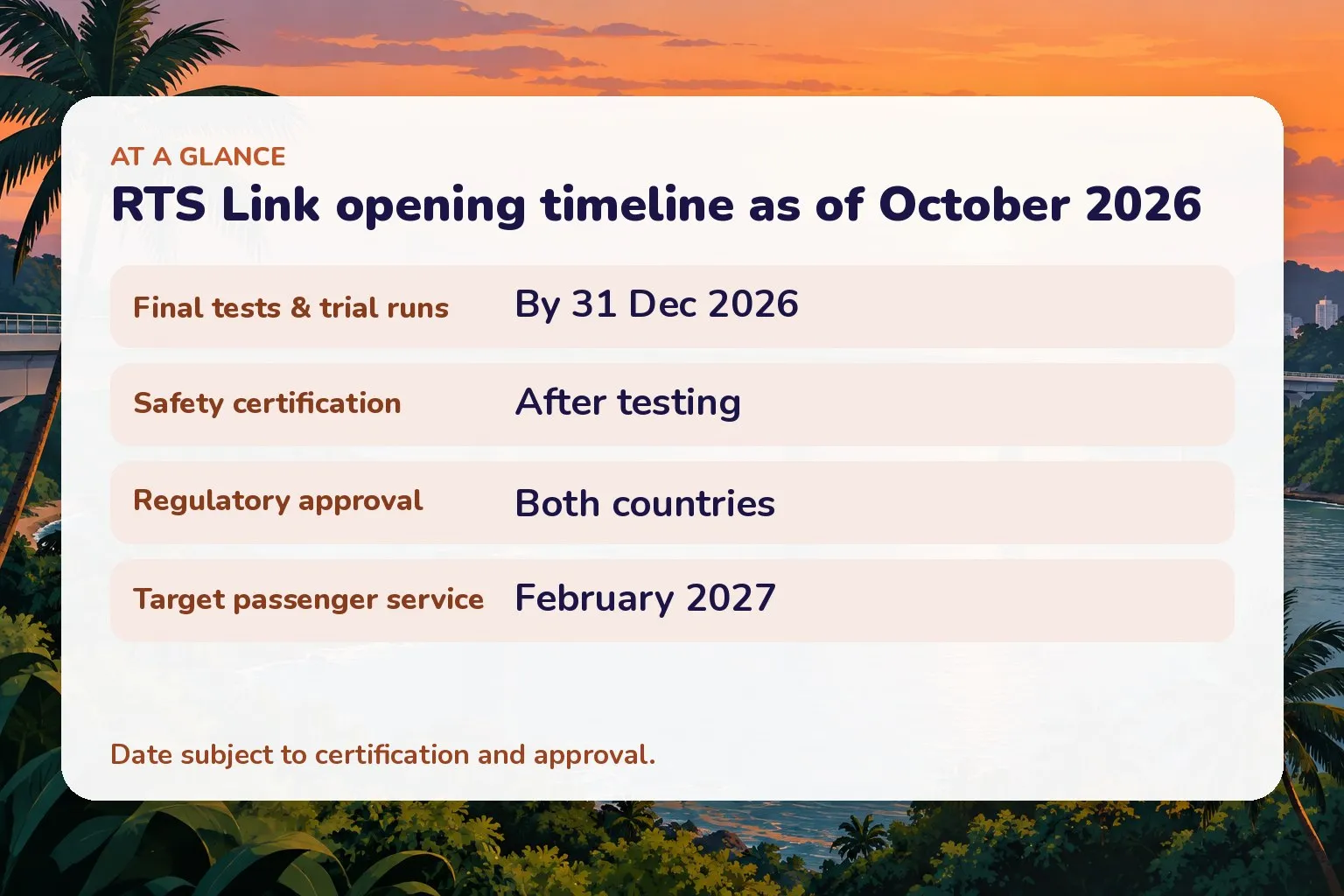
The remaining steps before the RTS Link can open.
The authorities were clear that the revised timeline is not yet a firm launch date. Infrastructure on both sides is described as substantially complete, but several steps remain before trains can carry passengers.
What still has to happen
The February 2027 target depends on a clear sequence:
- Finish testing — RTSO completes system integration tests and trial runs (targeted by 31 December 2026).
- Independent safety certification — an independent safety assessor must certify the line.
- Regulatory approval — authorities in Singapore and Malaysia review that certification and grant approval to begin passenger service.
Only after all three are done can a firm start date be set, which is why officials describe February 2027 as a target rather than a guarantee.
What about fares?
No official fare had been announced as of 26 October 2026. Both governments have said the price will be revealed in a joint announcement ahead of the opening, so travellers have time to get used to it. Figures quoted in the media so far are commentary, not confirmed prices — so treat any number you see now as unofficial until the two transport ministries publish the fare together.
How the RTS Link will work
The RTS Link is a roughly 4 km twin-track rail shuttle. The Singapore end, Woodlands North, is an interchange on the Thomson-East Coast Line (TEL), so you can transfer straight onto the MRT. The Johor end, Bukit Chagar, sits beside JB Sentral and its integrated transport and immigration complex.
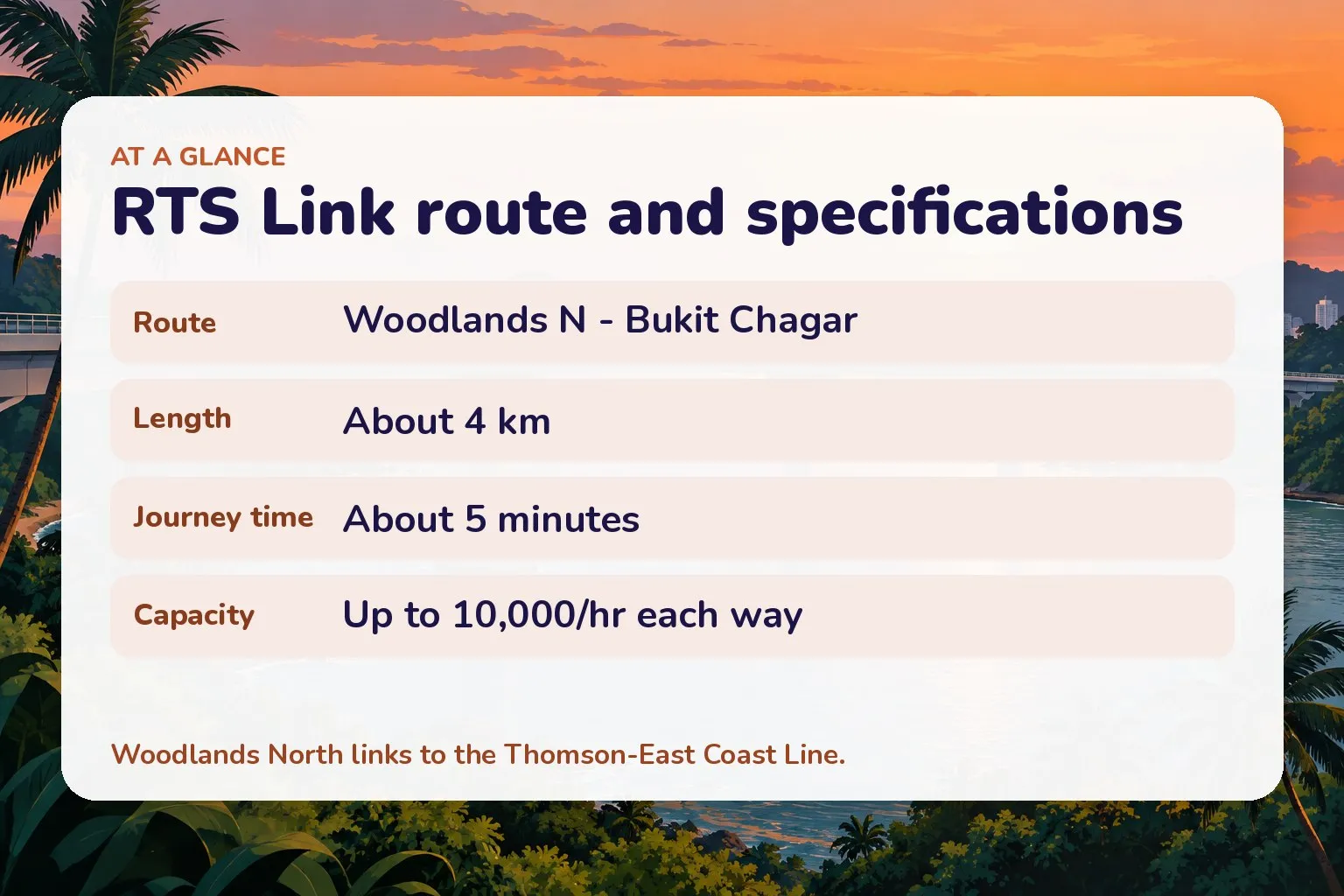
How the cross-border shuttle is designed to run.
The journey itself is designed to be about five minutes across the Strait of Johor. Both stations are planned with co-located immigration facilities, the same convenience the KTM Shuttle Tebrau already offers — you clear departure and arrival formalities at the station rather than at a separate land checkpoint.
Why it matters for crossing to JB
The Causeway is one of the busiest land borders in the world, and road queues at peak times can swallow an hour or more. The RTS Link is built to move up to 10,000 passengers per hour in each direction, which is expected to take a meaningful share of travellers off the road crossing over time. For weekend trips, it promises a fast, weather-proof alternative to sitting in Causeway traffic.
It is also expected to work alongside — and over time may reduce reliance on — the existing KTM Shuttle Tebrau train between Woodlands and JB Sentral.
Will it replace the Shuttle Tebrau?
For now, nothing changes for existing crossings: the Shuttle Tebrau, cross-border buses and the Causeway all keep running. Once the RTS Link opens, it is widely expected to take over much of the short-hop rail demand that the Shuttle Tebrau serves today, given its higher capacity and more frequent service. The Malaysian government has, however, signalled it would like to keep some Shuttle Tebrau service running rather than close it outright. Until there is an official decision, assume both can coexist and plan around whichever is actually operating on your travel date.
A practical point for weekend trippers: the RTS Link terminals are purpose-built with integrated immigration, so the pinch points will shift from road queues to station crowd management at peak hours (Friday evenings, Sunday nights and the eve of public holidays). Those remain the busiest windows whichever mode you take.
Getting to JB in the meantime
Until the RTS Link opens, the established options still apply. Buses are the cheapest, the Shuttle Tebrau is the quickest across the border today, and driving is the most flexible if your car has a valid Malaysia Vehicle Entry Permit. See our guide to getting to JB from Singapore for the full comparison, our VEP guide if you are driving, and Woodlands vs Tuas to pick a checkpoint.
Entry rules and dates can change — always confirm with LTA and check our Malaysia entry requirements guide before you travel.
Related
Sources
- Joint News Release: Grantors Informed by RTSO that RTS Link Service Commencement Targeted for February 2027 — Land Transport Authority (LTA) & Ministry of Transport, Malaysia (as of October 2026)
- Factsheet: Updates on the Johor Bahru - Singapore Rapid Transit System Link — Land Transport Authority (LTA) (as of October 2026)